.jpg)
by kristin friedery
we step outside into the heat. dry heat with sand and dirt blowing all around us. a group of men and women are hurrying by in their robes and sandals, entering a nearby building. following them, we discover a group of people crowding into a room. it seems as though there are too many people for the space, but everyone keeps making room for the next person who walks through the door. there is a feast on the table and everyone is beginning to wash their hands and arms before diving in to share the food. they all seem to know and love each other. once they begin eating, dozens of small conversations begin, ranging from the serious debate in the corner to the raucous laughter across the table from where we stand. once the meal is over, a man stands up and begins to speak. he welcomes his brothers and sisters in the name of the risen one. they all seem intimately familiar with the man to whom he refers. they turn to each other and embrace, greeting those around them as family. a basket is passed around and returned to the front of the room overflowing with coins from the pockets of the crowd. the man who is still standing begins to speak. he speaks words of love and hope. he speaks of this risen one, Jesus, with deep reverence. he entreats those in the room to continue to spend time with each other, to remember the words of Jesus and to act on his teachings. the afternoon darkens to evening and eventually to night. the man finishes speaking and the crowd once again breaks into smaller conversations. they ask about families and friends. people start to drift out of the door, on their way home. a few people who have travelled far to be at this meeting discuss arrangements for staying with their hosts. we exit the room and hop back into our delorean and zoom to present day.
but we have a quick stop to make first. we park in front of a building that is non-descriptive, except for a cross over the door. we are again greeted by a crowd of people flowing through the door. they seem excited to see each other and greet each other with hugs and high fives. once inside the building, they mingle in the lobby area. it appears that the majority of them know each other well. a few outsiders cling to the perimeter of the room, but not for long. they are warmly greeted and welcomed by members of the group. eventually everyone moves into a larger room with chairs. there is music playing and people singing along. a short sermon dedicated to the command given by Jesus to "love one another," afterwhich communion is served. the people serve each other the bread and the wine, clearly relishing the meaning behind the ceremony. the service closes with more singing. a few people leave quickly, but the majority stick around to visit with each other more. as they leave, some drop a few bills from their wallets and purses into boxes set up by the doors. the boxes are labeled "help the community."
the common thread between the early church and this modern church is the people. they are both about a community coming together to worship God through interacting with each other, singing, listening, giving, eating, etc... church isn't about when or where or what...it is about the community of believers coming together to support and love, challenge and grow. a church isn't the big brick building on the corner in town, the community would exist without the bricks and mortar, just as it did in the homes of the early church members.
Showing posts with label Not A Building Campaign. Show all posts
Showing posts with label Not A Building Campaign. Show all posts
the corner church
by Austin Pfeiffer
The cities of the south are peppered with steeples, bricks, church signs, and parking lots. In southern California there are Catholic sanctuaries and mega churches occupying huge plots of property. In these worlds I discovered house churches. House churches, to me, are the absolutely most poignant expressions of the fundamentals of the gospel. The deconstruction of bureaucracy, the authenticity and intimacy in small groups of people, make it simple to live out the loving of the poor and learning about the Bible.
Our expression of it works because we act as a reaction to a culture of inflated sentiments. In other words, we (our community) live in a city of impotent churches and as such we express the Gospel in very elemental ways. When I lived in Boston, I began an appreciation of the local church. In a society of hostility you recognize the need for organization. It is right to resist domination or hegemony, because they seem to detract from so many Gospel precepts. On the other hand, sometimes the local church is a force of good and healthy organization.
Throughout the past month we've looked at denominations, mega churches, and house churches. The good and bad of these have been parsed by personal opinions, but here's where I land on them all. I like the local church, mostly because when it calibrates itself well, its a reasonable size group of people, comprised of generations, races, and alternative view points, all coordinating in grace of differences to impact their local world.
When you take the Gospel lifestyles of house churches, something really only these types of groups can navigate with intensity and constancy, and you blend them into a city of local churches, you see the Gospel come alive. I am not afraid to say when you look at a centralized church, one singular location defined as the place where you find that "body" in most ways, there is something lost. There is something corporate and lacking of vibrant identity in such "brand standardization." So I say fight on corner church, keep opening your doors to the neighborhood and encouraging your people to use their homes. Your people live next door, and when that is the case, a lifestyle happens and the Gospel is realized.
The cities of the south are peppered with steeples, bricks, church signs, and parking lots. In southern California there are Catholic sanctuaries and mega churches occupying huge plots of property. In these worlds I discovered house churches. House churches, to me, are the absolutely most poignant expressions of the fundamentals of the gospel. The deconstruction of bureaucracy, the authenticity and intimacy in small groups of people, make it simple to live out the loving of the poor and learning about the Bible.
Our expression of it works because we act as a reaction to a culture of inflated sentiments. In other words, we (our community) live in a city of impotent churches and as such we express the Gospel in very elemental ways. When I lived in Boston, I began an appreciation of the local church. In a society of hostility you recognize the need for organization. It is right to resist domination or hegemony, because they seem to detract from so many Gospel precepts. On the other hand, sometimes the local church is a force of good and healthy organization.
Throughout the past month we've looked at denominations, mega churches, and house churches. The good and bad of these have been parsed by personal opinions, but here's where I land on them all. I like the local church, mostly because when it calibrates itself well, its a reasonable size group of people, comprised of generations, races, and alternative view points, all coordinating in grace of differences to impact their local world.
When you take the Gospel lifestyles of house churches, something really only these types of groups can navigate with intensity and constancy, and you blend them into a city of local churches, you see the Gospel come alive. I am not afraid to say when you look at a centralized church, one singular location defined as the place where you find that "body" in most ways, there is something lost. There is something corporate and lacking of vibrant identity in such "brand standardization." So I say fight on corner church, keep opening your doors to the neighborhood and encouraging your people to use their homes. Your people live next door, and when that is the case, a lifestyle happens and the Gospel is realized.
the mega church

by Austin Pfeiffer
Why hate on the mega churches? Its a good question. Citizens are not ambivalent to these constructs. Some in America find a strange pride in the size of their church, as if to imply it might give credence to the legitimacy or talents of its leadership and members. Others are quick to create a legalistic standard of rebuke against their relevance or necessity. Whenever young radicals want to create a standard, they are dangerously limiting possible future considerations. Just because an idea is progressive does not make it open minded and Paul understood this when he said, "everything is permissible, but not everything is beneficial."
So where can we land on mega churches? The definition of a mega church fluctuates, but lands somewhere between 1000-2000 people attending the church in weekly worship. My contention? If we are to be intelligent and reasonable, we must admit mega churches are certainly permissible as a means of living out Jesus' ideas. Are they beneficial? For the most part, no. To start with a metaphor, can you repair a dam with play-doh and a hammer, certainly it is possible, but is it the best understanding of how to execute the exercise at hand?
In our time the Church has become a space of individual service. The mega church is a place where people can certainly come and in effectively designed ways hear compelling points about Christianity, but in many ways they stifle the most fundamental purposes of the church. First, these institutions spend enormous amounts of money on administrative staff members, paper for communication and publicity, and require insane amounts of effort to simply keep the organization solvent. If it desires to make a swift movement in a direction of purpose, it is not possible, because keeping the staff paid and relevant, to justify the buildings on a campus, they are incapable of flexing. Of course you could argue because of their stature they are more equipped to make large impacts. Yes, they may have the resources, but the accessibility is not there and the consensus of people and bureaucracy of ownership will inevitably stone wall progress.
We are not talking about some radical deconstruction of all churches which ignores scripture or seeks to trivialize the Bible's claims into completely literal and blanket ideas. If churches are a place where people worship, then a space with thousands of dollars in speakers and choreographed music leaves little to the corporate expression. People cannot hear each other singing in unison, and the priesthood of the microphone creates a leadership hierarchy in pageantry, not expression of a culture. If churches are a place where the hurting, hungry, and naked come, then a place where the pastors need to be reached by phone in a corner office, the kitchen is a vacant space that never sees the stranger from the street, and the buildings have no clothing closet, are functioning in a bloated fashion and missing the point of church in the first place.
So can a mega church work? Of course, the question is, do their kitchen's serve the homeless? Do their buildings house the homeless? Can a stranger talk to their leaders? If the culture of a church is to create an organization that attracts people, they will attract those whose children can be entertained or whose hearts find the recreation of live music pleasant, but no, they will not make room for the homeless, the stranger, the hurting of the neighborhood they exist in. Are they permissible, yes, beneficial? I will take a chance and say no.
treasures from the storeroom
by eric lange
Denominationalism has a spotty record within church history. Despite Jesus’ prayer that his followers “may all be one” after he has gone (John 17:21), the past two thousand years have shown that Christians are more likely to separate themselves from one another based upon doctrinal, practical (and political) reasons, often through tremendous fighting, turmoil, and bloodshed. The Eastern and Western churches split a thousand years ago; five hundred years ago the Protestants distanced themselves from Catholics, and these splits have continued until there are now as many as 40,000 different denominations worldwide.
Denominations have divided Christians into different camps where each advocates their own spiritual practices and theology as correct while denying the validity of other traditions (even labeling them as un-Christian). Within the greater Christian tradition, this culture of denominationalism has accentuated the differences between different groups, and we often have confused the basic message of the Gospel by highlighting the particular ‘wedge issues’ that obscure the work of Jesus in the world with esoteric discussions that someone following Jesus will struggle to comprehend.
Denominations have all too often promoted their particular style as the only way to follow the teachings of Jesus. In so doing, they have suppressed dynamic and creative expressions of faith: they can force people into rigid systems of thinking and ways of practice that inhibit more genuine spiritual and theological understanding. In these cases, leaving denominational ties behind has been a welcome change: people have broken out of oppressively strong hierarchies in order to discover a truer, more authentic faith that fits their particular context. It appears that this recent ambivalence towards denominations brings us back to the “true” church that Jesus had envisioned. After all, how else could we unify the greater Church except by rejecting denominations?
Unfortunately, this rejection of denominations may only follow the greater pattern of church history towards even greater separation and fragmentation within the Church. In past eras, people creating new forms of faith still relied on others to create new denominations; this kind of support seems unnecessary in our individualistic culture. Without denominations (or a close affiliation to the traditions represented by a particular denomination) Christians increasingly belong to isolated churches with no connections to the greater Church body and the valuable traditions within denomination.
An individualized focus on spirituality can limit growth because it lacks continuity with the greater history of the Church. Along with their many flaws, each denomination holds remarkable depth and insight within their understanding of faith and the nature of their spiritual practices. Denominations are not created in a vacuum; they reflect the contexts in which they were created, and each one represents how people have tried to understand how the teachings of Jesus can transform their particular setting. In most cases, the greatest depth within these experiences can only be mined within a congregation that shares its commitment to its spiritual legacy and tradition.
Denominations are at their most vibrant when people belonging to them can be “like the owner of a house who brings out of his storeroom new treasures as well as old” (Matthew 13:35), because their connection to the greater tradition can provide perspective on insight to the spiritual realities they face today.
Denominationalism has a spotty record within church history. Despite Jesus’ prayer that his followers “may all be one” after he has gone (John 17:21), the past two thousand years have shown that Christians are more likely to separate themselves from one another based upon doctrinal, practical (and political) reasons, often through tremendous fighting, turmoil, and bloodshed. The Eastern and Western churches split a thousand years ago; five hundred years ago the Protestants distanced themselves from Catholics, and these splits have continued until there are now as many as 40,000 different denominations worldwide.
Denominations have divided Christians into different camps where each advocates their own spiritual practices and theology as correct while denying the validity of other traditions (even labeling them as un-Christian). Within the greater Christian tradition, this culture of denominationalism has accentuated the differences between different groups, and we often have confused the basic message of the Gospel by highlighting the particular ‘wedge issues’ that obscure the work of Jesus in the world with esoteric discussions that someone following Jesus will struggle to comprehend.
Denominations have all too often promoted their particular style as the only way to follow the teachings of Jesus. In so doing, they have suppressed dynamic and creative expressions of faith: they can force people into rigid systems of thinking and ways of practice that inhibit more genuine spiritual and theological understanding. In these cases, leaving denominational ties behind has been a welcome change: people have broken out of oppressively strong hierarchies in order to discover a truer, more authentic faith that fits their particular context. It appears that this recent ambivalence towards denominations brings us back to the “true” church that Jesus had envisioned. After all, how else could we unify the greater Church except by rejecting denominations?
Unfortunately, this rejection of denominations may only follow the greater pattern of church history towards even greater separation and fragmentation within the Church. In past eras, people creating new forms of faith still relied on others to create new denominations; this kind of support seems unnecessary in our individualistic culture. Without denominations (or a close affiliation to the traditions represented by a particular denomination) Christians increasingly belong to isolated churches with no connections to the greater Church body and the valuable traditions within denomination.
An individualized focus on spirituality can limit growth because it lacks continuity with the greater history of the Church. Along with their many flaws, each denomination holds remarkable depth and insight within their understanding of faith and the nature of their spiritual practices. Denominations are not created in a vacuum; they reflect the contexts in which they were created, and each one represents how people have tried to understand how the teachings of Jesus can transform their particular setting. In most cases, the greatest depth within these experiences can only be mined within a congregation that shares its commitment to its spiritual legacy and tradition.
Denominations are at their most vibrant when people belonging to them can be “like the owner of a house who brings out of his storeroom new treasures as well as old” (Matthew 13:35), because their connection to the greater tradition can provide perspective on insight to the spiritual realities they face today.
Loving Jesus and the origins of America
by Paul Smith
I am becoming ever-so wary of generalized statements condemning America and, in the same breath, an affirmation of the kingdom of God. I have heard the clichés and I believe them (“I am in this world but not of it”). Fundamentally, we have an identity found not based in this temporal world but in an eternal reality.
Nevertheless, we are here. In America.
We have a driver’s license. We vote, pay taxes, and follow laws. We obey stoplights and drive on the right side of the road.
The profundity of the statement that “all men are created equal” or “For God so loved the world that he gave his only son”…
If you want to understand America, you look at the origins and original intent. Similarly, if you want to understand Christianity, you look at the origins and original intent. You don't look at the Inquisition to know Christianity or the KKK to know America. Those groups and events diverge from the original intent and do not define it.
We live in a time where we like having our own titles. Here are a few:
(and I have used these for myself, so they are simply self-deprecating)
I am an independent (yet ironically dependent on that title).
I am a follower of the teachings of Jesus (not a Christian because of negative connotations).
We are afraid of being tied to a more generalized title, as we are unique and have our own perspectives on issues. But we think if we just get the title right, then we can actually do what is right and just. The title becomes then a hindrance and distraction rather than a call to belief and action. The most mature people I can imagine are so unconcerned with image and title, with fame or fortune. It’s not that they might consider them, but they have dived into something so much deeper and more important. They don’t deserve their time. The two that come to mind are Mother Teresa and Abraham Lincoln. Business needs to be done and these trivialities can be dealt with later.
As a younger member of the church, I have a hesitancy to closely associate myself with America. It’s messy. Our nation has done great things and has done terrible things and tying myself to both is, well, a bit uncomfortable. I have this same frustration with the church. I wonder if I stop spending time defining my personal ideology and start doing, this will be a better life lived?
I am becoming ever-so wary of generalized statements condemning America and, in the same breath, an affirmation of the kingdom of God. I have heard the clichés and I believe them (“I am in this world but not of it”). Fundamentally, we have an identity found not based in this temporal world but in an eternal reality.
Nevertheless, we are here. In America.
We have a driver’s license. We vote, pay taxes, and follow laws. We obey stoplights and drive on the right side of the road.
The profundity of the statement that “all men are created equal” or “For God so loved the world that he gave his only son”…
If you want to understand America, you look at the origins and original intent. Similarly, if you want to understand Christianity, you look at the origins and original intent. You don't look at the Inquisition to know Christianity or the KKK to know America. Those groups and events diverge from the original intent and do not define it.
We live in a time where we like having our own titles. Here are a few:
(and I have used these for myself, so they are simply self-deprecating)
I am an independent (yet ironically dependent on that title).
I am a follower of the teachings of Jesus (not a Christian because of negative connotations).
We are afraid of being tied to a more generalized title, as we are unique and have our own perspectives on issues. But we think if we just get the title right, then we can actually do what is right and just. The title becomes then a hindrance and distraction rather than a call to belief and action. The most mature people I can imagine are so unconcerned with image and title, with fame or fortune. It’s not that they might consider them, but they have dived into something so much deeper and more important. They don’t deserve their time. The two that come to mind are Mother Teresa and Abraham Lincoln. Business needs to be done and these trivialities can be dealt with later.
As a younger member of the church, I have a hesitancy to closely associate myself with America. It’s messy. Our nation has done great things and has done terrible things and tying myself to both is, well, a bit uncomfortable. I have this same frustration with the church. I wonder if I stop spending time defining my personal ideology and start doing, this will be a better life lived?
i am not a supporter of house church(es)
by Jason Evans
27 June 2007 from the ecclesia collective
I have often times been asked why we believe in the “house church”
model. I don’t. In fact, I try hard not to use that phrase any longer.
As a model, it is as full of flaws as any other. But I guess I am
still a strong proponent for this not as a model as much as the result
of my theology and convictions.
There is one reason why I highly value the way we have chosen to
function: sustainability. I mean this in many ways:
- it’s economically more sustainable
- it’s sustainable in the sense that it is not personality dependant
on one individual and therefore can continue to exist and evolve even
as “leaders” and other participants change
- it’s also more sustainable on an environmental level, making use of
space that already exists rather then building/renovating another is
important to me
- it enhances the use of resources for justice and mission by cutting
down, if not completely eliminating, overhead
It’s also more just in the sense that it allows more participation by
many. Because of the economic implications, the marginalized and the
poor can have greater access and more prominent voice. They also have
a greater opportunity to initiate something more “organic” (to use
Neil Cole’s language) themselves rather than be dependent upon an
ecclesiastic system that by and large does not advocate for them at
times. I know this is not true across the board but seeing as the poor
are one of the most mentioned subjects in Scripture their access and
interaction within ecclesiastic structures/models should be a priority
I am thinking.
As well, what my experience in recent years has provided that my
previous experience did not is a slow detoxification of three things:
1-the identity of a leader, 2-our idea of fulfilled mission and 3-the
identity of a congregation.
For me, it has challenged my own dependency on authority and false
ideals of success. It has provided an empty canvas for us to think
more creatively about how we participate with Jesus and his kingdom.
It has also provided ample space for those that have participated in
community with us over the years to consider their action rather than
rely on a leader to meet their needs.
While I don’t always appreciate the term “house church”�the name is a
misnomer for many and implies many things that I don’t necessarily
want to imply�I do appreciate the response it evokes in many. The
phrase itself seems to be received as a threat to many peoples’
system. At first, it took me awhile to get over that. Now, I
appreciate it. I’m forced to wonder, ‘Why is this such a threat to
you? Why does this raise so much emotional reaction?’ It implies, to
me, that there is something prophetic about it. So, I have no interest
in it as a model but I appreciate, still, the implications of being
the church in this way.
…. So, maybe I am a supporter.
27 June 2007 from the ecclesia collective
I have often times been asked why we believe in the “house church”
model. I don’t. In fact, I try hard not to use that phrase any longer.
As a model, it is as full of flaws as any other. But I guess I am
still a strong proponent for this not as a model as much as the result
of my theology and convictions.
There is one reason why I highly value the way we have chosen to
function: sustainability. I mean this in many ways:
- it’s economically more sustainable
- it’s sustainable in the sense that it is not personality dependant
on one individual and therefore can continue to exist and evolve even
as “leaders” and other participants change
- it’s also more sustainable on an environmental level, making use of
space that already exists rather then building/renovating another is
important to me
- it enhances the use of resources for justice and mission by cutting
down, if not completely eliminating, overhead
It’s also more just in the sense that it allows more participation by
many. Because of the economic implications, the marginalized and the
poor can have greater access and more prominent voice. They also have
a greater opportunity to initiate something more “organic” (to use
Neil Cole’s language) themselves rather than be dependent upon an
ecclesiastic system that by and large does not advocate for them at
times. I know this is not true across the board but seeing as the poor
are one of the most mentioned subjects in Scripture their access and
interaction within ecclesiastic structures/models should be a priority
I am thinking.
As well, what my experience in recent years has provided that my
previous experience did not is a slow detoxification of three things:
1-the identity of a leader, 2-our idea of fulfilled mission and 3-the
identity of a congregation.
For me, it has challenged my own dependency on authority and false
ideals of success. It has provided an empty canvas for us to think
more creatively about how we participate with Jesus and his kingdom.
It has also provided ample space for those that have participated in
community with us over the years to consider their action rather than
rely on a leader to meet their needs.
While I don’t always appreciate the term “house church”�the name is a
misnomer for many and implies many things that I don’t necessarily
want to imply�I do appreciate the response it evokes in many. The
phrase itself seems to be received as a threat to many peoples’
system. At first, it took me awhile to get over that. Now, I
appreciate it. I’m forced to wonder, ‘Why is this such a threat to
you? Why does this raise so much emotional reaction?’ It implies, to
me, that there is something prophetic about it. So, I have no interest
in it as a model but I appreciate, still, the implications of being
the church in this way.
…. So, maybe I am a supporter.
Not A Building Campaign
We have written a letter to the Christian leaders of our city. You can copy and/or print it here. We encourage you to forward it to the leadership of your church and edit it to the purposes of your city.
August 31st, 2009
To the leaders of the local church,
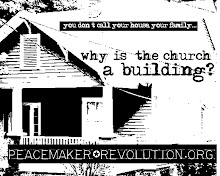
We are a group of young Christian activists known as Peacemaker Revolution. We are rooted in three houses in Winston-Salem, NC. We meet in our homes to read the Bible, coordinate feeding the hungry, and connecting members of different churches across our city. We are writing you to stimulate awareness of how we feel about the American Church and our generation. We live the way we do because it is a compelling avenue to exercise Christianity in our time and place. We are calling this campaign “You don’t call your house your family, why is your church a building?”
We believe in the local church. We think the local church is a pivotal organizer of people to provide Jesus’ love to its neighborhoods and the conduit for his claim that his people will do greater things than he.[1] We also see troubling things in our country where the building, the institution, the organization, and the maintenance of these things is more consuming of time and resources than the actual serving of and service by the people.
Our group is committed to the feeding of the hungry, providing the most elementary medical care, loving the disenfranchised, and healing the flagrant racial divide of our city, because more than anything these are the most literal manifestations of the Gospel love Jesus calls us to. Our choice is to be in our churches, participating in those communities, not breaking off to construct more hedges and alienating ourselves from other generations and people different from ourselves.
As a group of young people who participate in six different churches across six different denominations on any given weekend, we want to make a few things clear to the generation leading us. We are not compelled to participate in a body because of its music, its building, its marketing, or its programs, nor do we believe the non-believing communities of our city are compelled by these initiatives. We are not deep with wisdom or experience, but we do live in the trenches of the art scene, the college and post-collegiate arenas, and we see people longing not for a well-oiled organization or an attractive worship space, but a gospel lived out. For our campaign, we are asking your church for three things.
First, to visit our website, www.peacemakerrevolution.org and sign our pledge to foster a church whose identity is a community of people with the purpose of love as an alternative to creating a centralized structure. Second, to visit our site over the next month to read articles by our community and other people living like us around the country in the context of these ideas. While we do not have it all figured out, we hope you can see what young people are thinking and feeling. Third, we would like to connect with your church and find out how we can participate in what you are doing or help encourage intentional community within your body since we see the local church as the most important catalyst of what Jesus clearly calls us to, love through compassion, mercy, and justice in our city. These are not just words for us, we are invigorated to participate. Please allow us to connect with your leaders over a cup of coffee, have the opportunity to brain storm with your community, and please invite us to participate in what your church is doing to live out the Gospel.
Thank you and God bless,
Austin Pfeiffer and PeacemakerRevolution.org
[1] John 14:12

Subscribe to:
Posts (Atom)